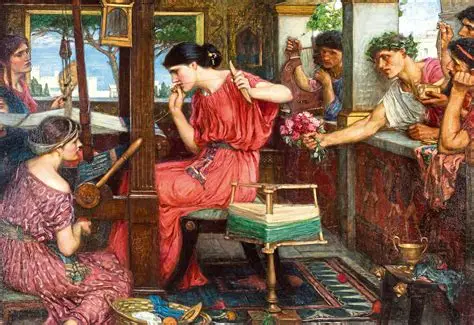
John William Waterhouse, Penelope and the Suitors, 1912. Fresco
transferred to canvas, 126 × 152 cm.
Now housed at the Aberdeen Art Gallery in Scotland, Penelope and the Suitors (1912) by John William Waterhouse was commissioned during Britain’s women’s suffrage movement. During that period, many
universities and disciplines, such as politics, were closed to women, and women therefore turned to the domestic arts to socialise witheach other, attend lectures, and fulfill their ambitions.
Waterhouse was well known for his paintings that represented women from ancient Greek and Roman mythology in symbolism and rich colours. Both his parents were painters and worked with textiles;
Waterhouse was also sensitive in depicting the texture and drape of cloth through painting. He particularly favoured women from Homeric tales, such as Penelope, who was the epitome of a strong and loyal woman in Homer’s epic poem The Odyssey (written around 700 BC).
Some scholars believe that the name Penelope derives from the Greek noun πήνη (pḗnē), the thread wrapped on a spool or shuttle (weft), ready for weaving. Waterhouse depicts Penelope unravelling her work in the painting, as the thread-laden lantern suggests. She sits in front of her loom, holding a shuttle in her left hand and cutting a thread with her teeth. Two of her maids are seated on either side of her: one by the spun thread and one beside the loom. The eager and desperate suitors crowd around Penelope, who remains calm and focused on her weaving. The three young women are depicted as the three Fates.
As Penelope weaves, unravels, and cuts thread, she becomes a metaphor for control over her own fate, the flow of time, and the complexity of life. Notable is the multicoloured thread wrapped around the cage-like lantern. Typically, a shroud cloth is white or undyed, but Penelope’s cloth is multicoloured. A plain white cloth would have been easier and quicker to weave; thus, by choosing to weave a colourful cloth, Penelope set herself a more laborious task, further delaying her remarriage.
Penelope and the Suitors is a masterful painting that combines elements from classical mythology, detailed realism, and rich colour to communicate themes of loyalty, intelligence, patience, and female strength. It weaves the story of a woman’s grief, despair, and loyalty – a woman’s fate that was hanging on an unravelled thread. The exploration of this painting deepens the understanding of the historical and cultural significance of fabrics and needlework. It also speaks volumes during a period when women sought independence and used textiles – weaving and needlework arts – to support their endeavour of planning their destinies.
 grecianneedle.com